Onion - the missing ingredient for Sage Line 50 / Sage Instant accounts packs in Excel

Onion - the missing ingredient for Sage Line 50 / Sage Instant accounts packs in Excel
Full audit trails to underlying transactions from P&Ls, Balance Sheets, graphs, PivotTables, and departmental TBs in a stand-alone Excel file. Aged Debtors and Aged Creditor files too. Free 30 day trials. Download today at www.onionrs.co.uk

Thursday, 22 January 2026

Solis AI

I've had a Solis inverter (S5-EH1P3.6K-L) since July 2024, manually scheduling battery charging/discharging depending on time of year and weather conditions. I'd seen mention of Solis AI from time to time so I thought I'd have a poke around to see what I could find out. The first thing I discovered was that the firmware I had didn't support Solis AI. I tried to upgrade but it didn't work initially. However, with the help of the Solis Service Centre I eventually got it done. Now I had access to the Energy Management System (EMS) and Solis AI. After some initial poking around I decided I wanted to try to set up "Self Use" mode. Under Tariff Setting I was faced with the choice of "Fixed Tariff", "Dynamic TOU Tariff" or "Static TOU Tariff". I decided "Static TOU Tariff" was the most appropriate as I live in Northern Ireland where neither Octopus Energy nor Nord Pool are available - I'm on what used to be called an Economy 7 tariff (reduced rate overnight, 1-8AM in winter, 2-9AM in summer). I spent days wrestling with it to no avail. Then I decided to have a poke around the "Dynamic TOU Tariff" setting to see if it gave any inspiration. There I discovered that, if you chose Octopus Energy as your supplier you have to provide a Post Code for your location. BT4 wasn't acceptable as Octopus don't operate in Northern Ireland - so prices aren't available for that location. I decided to put N17 in instead as Octopus operate in London - just to see what happens if you get further. The closest tariff plan (as far as I could tell) to my situation was called "GO-FIX-12M-25-08-29". Then I had to choose a setting for "Actual Price Calculation". There were two options, "Coeff*(Net Elec. Price+Fixed Val1)+Fixed Val2" and "Coeff*(Net Elec. Price+Fixed Val1)+Fixed Val2 (Time Sharing)". The first only allowed one set of values to be input each day. The second ("Coeff*(Net Elec. Price+Fixed Val1)+Fixed Val2 (Time Sharing)") allowed input for multiple time slots per day. That looked like what I needed to set up different Day and Night rates. Epiphany! The Net Elec. Price is what is supplied by the link to Octopus data for N17 Time Of Use (TOU) tariffs. I had to record Coeff, Fixed Val1 and Fixed Val2. What if I could make Coeff*(Net Elec. Price+Fixed Val1) = 0? I set Coeff = 0, Fixed Val1 = 0 and Fixed Val2 = 0.286 for time period 00:00 - 02:00, the same for 02:00 - 08:00 except Fixed Val2 = 0.139 and the same again for 08:00 - 24:00 with Fixed Val2 = 0.286 again. After setting my Feed-In tariff I had this.
The TOU display confirms the correct prices for the different time periods. Now to see what that did?
Immediately, I'm drawn to the strategies decided by Solis AI. I thought it would set charging from 02:00 to 08:00 but it stopped charging at 04:30 with the battery at 95% and went into battery Standby until 08:00. The reasoning given is obvious when you think about it. It thinks no more than 95% will be needed for the rest of the day so we can avoid cycling the battery that extra 5% and let the grid take care of the load directly, at cheap rates, until 08:00. I'm impressed. It hasn't had any learning time yet but already seems to have made sensible calls that would have taken me time to assess and implement. I look forward to seeing what it can do going forward. I'm particularly interested to see what it might do to avoid potential clipping coming into the summer months. I'd be grateful for any helpful observations.

Thursday, 1 May 2025

Sage 50 SDO field names not necessarily the same as the ODBC names

A heads up, when working with Sage Data Objects, the field names are not necessarily the same as those recognised in ODBC queries. For example, the AUDIT_SPLIT table has a field called EXTRA_REF when using the ODBC driver which is called INTERNAL_REF in Sage Data Objects. Check out the SDO help file documentation if the expected field name (the ODBC name) doesn't work.

Thursday, 30 January 2025

PV bloopers by the "professionals" - Part 2

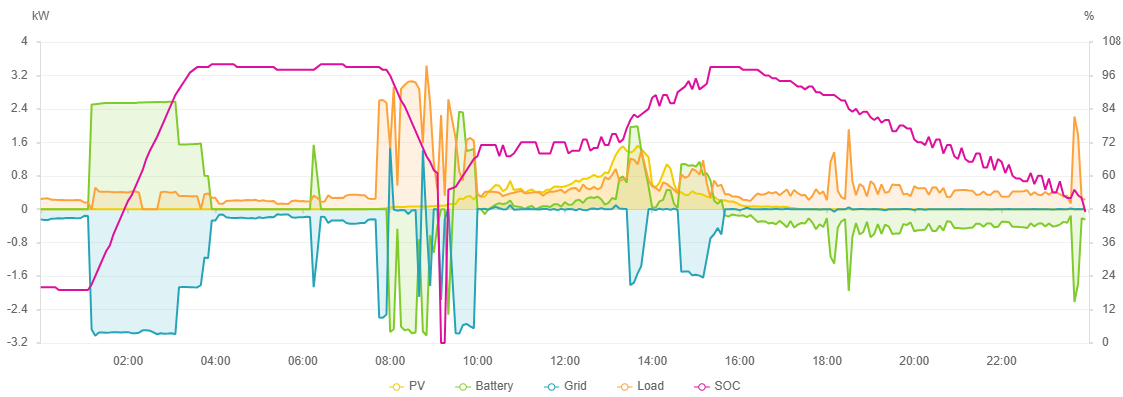
Having installed an Economy 7 (2 import and one export tariff) meter I arranged for an additional 3.6kWh Dyness battery to be added to my existing two battery array. Here's the day of the install:


The irregular State Of Charge % trace bothered me but I thought it might take some time for the batteries to "balance". Anyway, I got up in the middle of the night when the inverter was due to draw cheap electricity from the grid and this is what I found:


At around 1AM, when the inverter started its battery charging cycle, the load changed from around 0.2kW to around 1.4kW.  Something was very wrong. After researching the configuration of the battery stack, I discovered that the installer had configured them as 2 Master units and 1 Slave unit instead of 1 Master and 2 Slave units. This I fixed.

I dread to think of the consequences if this error had gone unchecked. Could the inverter or batteries have been irreparably damaged? Would there have been a significant financial penalty? I've resolved to always check what the "professionals" have done to the best of my ability. 0 for 2 (in American parlance) isn't very reassuring.

PV bloopers by the "professionals" - Part 1

I decided my solar panel setup could do with the help of an additional battery together with changing my tariff to Economy 7 (cheap nighttime electricity). I'd been drawing from the grid at night for a short time to get a feel for how it would all work. A meter change was required and an appointment was booked for the installation. 

Some time around 6 PM on the day of installation I went to my SolisCloud app. To my horror this is what I found:


Massive movements, something wasn't right. When I checked the meter I found that a clamp on one of the leads that reports import/export volumes to the system had been replaced the wrong way round! Put the clamp back the way it should be and, voila, back to normal:
Very disappointing. I dread to think of the consequences if I hadn't spotted the issue fairly quickly.

Wednesday, 25 May 2022

Microsoft Office UK/US language confusion

I've been having a nightmare with dates and spelling showing as US format. Here are my Windows settings:
and, here are my Office settings:
I wondered which sort of English that might be and so clicked on the “Add a Language” button to add “English (United Kingdom)”. This resulted in a changed display where “English” was replaced by “English (United Kingdom)”. 

I think most systems will be set to “Match Microsoft Windows [English]”. In spite of saying it matches Microsoft Windows, it doesn’t actually match the UK bit of the Windows setting and, instead, uses US English! 

Now that it reads “Match Microsoft Windows [English (United Kingdom)]”, I'm getting what I want. How confusing is that?

Wednesday, 16 June 2021

Excel High CPU Usage


My laptop sounded like it was working hard so I opened up Task Manager in Windows to see what was going on and, to my surprise, I found that Excel was reporting greater than 50% CPU usage. Permanently it would seem. After a lot of blind alleys I eventually discovered that the zoom setting on the tabs seemed to be the critical factor. At 100% zoom on all 12 tabs the CPU problem persisted. Setting them all to 90% zoom seemed to make the problem marginally worse (approaching 60% CPU usage). Setting them all to 80% zoom seemed to make the problem go away. 

Searching for what might be the issue, I noted that freeze panes was active on one of the sheets such that the scrolling part of the screen was only just visible at 80% zoom. Trial and error determined that the scrolling part of the screen disappeared at 82% zoom and that was the exact zoom level that the CPU usage problem occurred. I removed freeze panes from the sheet and set the ScrollArea in worksheet properties to achieve the same sort of "locked area" effect that freeze panes was used to create and had a usable workbook again.

Tuesday, 23 June 2020

Trouble with Time (Text ODBC driver)


I have a text file with Date and Time fields containing the values 01/01/2020 and, for the time field, 13:00:22

In Microsoft Query the values show as 2020-01-01 00:00:00 and 1899-12-30 13:00:22

When returned from MS Query to appropriately formatted columns in a Query Table they show as 01/01/2020 and 00:00:00

However, if I create a DateTime field as Date+Time it shows as 01/01/2020 13:00:22

How to get the Time to show correctly in the Query Table?

Time + 2 as [Time]

This shows as 13:00:22 in the Query Table. Took me ages to figure this out. I spent ages playing around with the DateTimeFormat option in the Schema.ini to no avail. It seems that if MS Query returns anything prior to 01/01/1900 00:00:00 the time portion will always show as 00:00:00 in Excel